
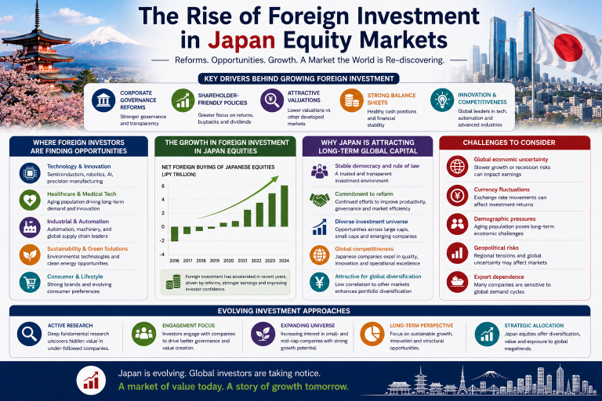
Japan has long been one of the world’s largest and most influential economies, yet for many years its stock market received less attention from international investors compared to markets such as the United States and certain emerging economies. In recent years, however, Japan has experienced a significant resurgence in global investor interest, driven by economic reforms, corporate governance improvements, attractive valuations, and changing global investment trends.
The growing popularity of the Japan equity fund among institutional and retail investors reflects this renewed confidence in the country’s stock market. As foreign capital continues to flow into Japanese equities, investors are increasingly recognising the opportunities available across a wide range of sectors and company sizes.
At the same time, evolving equity investment strategies have encouraged global investors to look beyond traditional markets and identify regions where long-term value creation remains compelling. Japan’s ongoing market transformation has positioned it as a key destination for those seeking diversification and growth potential.
Why Foreign Investors Are Paying Attention
Several factors have contributed to the increased interest in Japanese equities.
Historically, some investors viewed Japan as a mature economy with limited growth prospects. However, significant changes over the past decade have challenged this perception.
Key factors attracting foreign investment include:
- Corporate governance reforms
- Shareholder-friendly policies
- Attractive company valuations
- Strong balance sheets
- Economic modernisation initiatives
- Technological innovation
Many Japanese companies possess substantial cash reserves and operate globally competitive businesses. As governance standards improve and management teams focus more on shareholder returns, investors are finding greater value within the market.
This combination of stability and opportunity has made Japan increasingly attractive in a global investment environment characterised by uncertainty and changing economic conditions.
Corporate Governance Reforms as a Catalyst
One of the most significant drivers of foreign investment has been the improvement in corporate governance practices.
For many years, investors criticised certain aspects of Japanese corporate culture, including cross-shareholdings, limited shareholder engagement, and inefficient capital allocation.
Recent reforms have encouraged companies to focus more on:
- Shareholder returns
- Capital efficiency
- Transparency
- Independent board oversight
- Corporate accountability
These changes have increased investor confidence and encouraged greater participation from global asset managers.
As companies adopt more shareholder-friendly practices, including dividend increases and share buyback programs, foreign investors have become more willing to allocate capital to Japanese equities.
Attractive Valuations Compared to Global Markets
Valuation is another important factor driving foreign investment.
In many cases, Japanese stocks have traded at lower valuation multiples compared to their counterparts in other developed markets. This has attracted investors seeking opportunities where market prices may not fully reflect underlying business value.
Investors often evaluate metrics such as:
- Price-to-earnings ratios
- Price-to-book ratios
- Dividend yields
- Free cash flow generation
Many Japanese companies have historically maintained conservative balance sheets and significant cash reserves, creating potential opportunities for value-oriented investors.
As global markets become increasingly expensive in certain sectors, Japan’s comparatively attractive valuations continue to draw attention from investors looking for favourable risk-reward characteristics.
This valuation appeal has been particularly important during periods when investors seek diversification away from heavily concentrated markets.
The Role of Economic and Market Reforms
Government-led economic initiatives have also played a role in strengthening investor confidence.
Efforts to improve productivity, encourage innovation, and support sustainable economic growth have contributed to a more positive outlook for Japanese equities.
Reforms have focused on areas such as:
- Labor market modernisation
- Digital transformation
- Corporate competitiveness
- Capital market efficiency
- Entrepreneurship and innovation
While challenges remain, these initiatives signal a commitment to long-term economic development.
Investors often view policy stability and reform momentum as important factors when evaluating international markets. Japan’s efforts to modernise its economy have reinforced perceptions of a market that is evolving in a positive direction.
These reforms have helped create an environment that supports both domestic growth and international investment participation.
Technology and Innovation Driving Growth
Japan remains a global leader in several advanced industries.
The country is home to internationally recognised companies involved in:
- Robotics
- Automation
- Semiconductors
- Precision manufacturing
- Healthcare technology
- Advanced materials
As technological innovation becomes increasingly important to global economic growth, investors are paying closer attention to Japanese firms that possess unique expertise and competitive advantages.
Many companies are positioned to benefit from long-term trends such as:
- Artificial intelligence
- Industrial automation
- Aging populations
- Sustainable energy solutions
- Digital transformation
These structural growth opportunities have enhanced the appeal of Japanese equities among international investors seeking exposure to innovation-driven sectors.
The combination of technological leadership and attractive valuations creates a compelling investment narrative.
Increased Interest in Small- and Mid-Cap Companies
While large multinational corporations often receive the most attention, foreign investors are increasingly exploring Japan’s small- and mid-cap segments.
These companies may offer:
- Higher growth potential
- Market niche leadership
- Entrepreneurial management teams
- Undervalued opportunities
Many smaller businesses have benefited from governance reforms and operational improvements, making them more attractive to active investors. A growing number of investment professionals believe that some of the most compelling opportunities in Japan can be found outside the country’s largest and most widely followed companies.
As research coverage expands and investor awareness increases, foreign participation in these segments continues to grow. This trend contributes to broader market development and increased capital allocation across the Japanese economy.
Challenges That Investors Should Consider
Despite the positive momentum, investing in Japan is not without risks.
Potential challenges include:
- Global economic slowdowns
- Currency fluctuations
- Demographic pressures
- Geopolitical uncertainty
- Export market dependence
Japan’s aging population remains a long-term structural concern, and external economic conditions can significantly influence corporate earnings, particularly for export-oriented businesses.
Currency movements also play an important role for international investors. Changes in exchange rates can affect investment returns when converting profits back into home currencies.
Understanding these risks is essential for investors considering exposure to Japanese equities. A balanced assessment of opportunities and challenges helps support informed investment decisions.
The Future Outlook for Foreign Investment
The outlook for foreign investment in Japan remains encouraging.
Several trends are likely to continue supporting investor interest, including:
- Ongoing governance improvements
- Corporate restructuring initiatives
- Technological leadership
- Attractive valuations
- Growing shareholder focus
As Japanese companies continue enhancing efficiency and capital allocation practices, foreign investors may find additional opportunities for value creation.
Many market observers believe that Japan is still in the early stages of a broader transformation that could unlock significant long-term potential.
While market conditions will inevitably fluctuate, the structural improvements taking place across the Japanese corporate landscape provide reasons for sustained optimism.
Conclusion
The rise of foreign investment in Japan’s equity markets reflects a significant shift in global investor perception. Once viewed primarily as a mature and relatively stagnant market, Japan is increasingly recognised for its improving corporate governance, attractive valuations, technological innovation, and commitment to reform.
These developments have created a more compelling environment for international investors seeking diversification, value, and long-term growth opportunities. From large multinational corporations to emerging small-cap businesses, Japan offers a broad range of investment possibilities across multiple sectors.
Although challenges remain, the combination of structural reforms, shareholder-focused policies, and economic modernisation continues to strengthen the market’s appeal. As foreign investment flows increase and confidence grows, Japan is likely to remain an important destination within global equity portfolios for years to come.

